Important Ideas
1. How are the layers of the Earth's interior differentiated?
2. How does the composition of each layer
3. How does activity taking place in the interior affect the activity and physical nature of the Earth's surface?
Monday, September 23, 2013
Independent and Dependent Variables (Answers)
1. A group of college students were
given a short course in speed-reading. The instructor was curious if a
monetary incentive would influence performance on a reading test taken
at the end of the course. Half the students were offered $5 for
obtaining a certain level of performance on the test, the other half
were not offered money.
Independent variable:
Monetary incentive ($5 or no money)
Dependent variable:
Performance on reading test
Experimental group: $5
group (receive monetary incentive)
Control group: $0 group (no
monetary incentive)
2. A social psychologist thinks that
people are more likely to conform to a large crowd than to a single
person. To test this hypothesis, the social psychologist had either one
person or five persons stand on a busy walking path on campus and look
up. The psychologist stood nearby and counted the number of people
passing by who also looked up.
Independent variable: Size
of group (5 people or 1 person)
Dependent variable:
Conformity (measured by number of people looking up)
Experimental group: People
passing 5 person group
Control group: People
passing single person. (This group gets “less” of the independent
variable)
3. To test a new voice feature in a
cockpit design a flight simulator was used. The simulator was
programmed to give visual readings of flight information, or to give
visual and auditory (voice) readings of flight information. All
test pilots were put through a simulated emergency landing procedure,
but were randomly assigned to the visual, or visual and auditory
conditions. Flight experts rated each pilot’s performance in the
simulator on a scale of 1 (very poor) to 10 (excellent).
Independent variable:
Presence or absence of auditory (voice) readings. (All pilots received
visual readings, so that is a constant variable.)
Dependent variable: Ratings
of pilots’ performance
Experimental group: Pilots
in auditory readings condition (visual + auditory)
Control group: Pilots in
visual reading only condition (no auditory)
Thursday, September 19, 2013
Independent and Dependent Variables
1. A group of college students were
given a short course in speed-reading. The instructor was curious if a
monetary incentive would influence performance on a reading test taken
at the end of the course. Half the students were offered $5 for
obtaining a certain level of performance on the test, the other half
were not offered money. Based on the situation presented, identify the:
Independent variable:
Dependent variable:
Experimental group:
Control group:
2. A social psychologist thinks that
people are more likely to conform to a large crowd than to a single
person. To test this hypothesis, the social psychologist had either one
person or five persons stand on a busy walking path on campus and look
up. The psychologist stood nearby and counted the number of people
passing by who also looked up.
Independent variable:
Dependent variable:
Experimental group:
Control group:
3. To test a new voice feature in a
cockpit design a flight simulator was used. The simulator was
programmed to give visual readings of flight information, or to give
visual and auditory (voice) readings of flight information. All
test pilots were put through a simulated emergency landing procedure,
but were randomly assigned to the visual, or visual and auditory
conditions. Flight experts rated each pilot’s performance in the
simulator on a scale of 1 (very poor) to 10 (excellent).
Independent variable:
Dependent variable:
Experimental group:
Control group:
Tuesday, September 17, 2013
Monday, September 16, 2013
Density
Density - a measure of the compactness of a substance, expressed as its mass per unit volume.
Density = mass (g) / volume (mL)
Mass - a measure of how much matter is in an object.
Volume - the amount of space occupied by a three-dimensional object or region of space.
Saturday, September 14, 2013
Friday, September 13, 2013
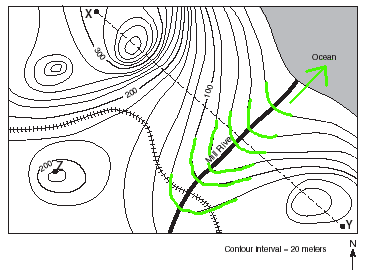
Topographic Maps
Aim: How do we map the surface of the Earth?
Notes Given to Students: Guided Notes: Topographic Maps
Drawing Contours Practice: Drawing Contour Lines
Calculating Gradient Practice: Calculating Gradients
Topographic Maps
maps showing the relief features of the earth's
surface, usually by means of contour lines to show changes in elevation.
Contour Line -
a line joining points of equal elevation on a surface.
Subscribe to:
Posts (Atom)