
Saturday, September 14, 2013

Friday, September 13, 2013
Topographic Maps
Aim: How do we map the surface of the Earth?
Notes Given to Students: Guided Notes: Topographic Maps
Drawing Contours Practice: Drawing Contour Lines
Calculating Gradient Practice: Calculating Gradients
Topographic Maps
maps showing the relief features of the earth's
surface, usually by means of contour lines to show changes in elevation.
 | ||
The picture above is an example of a field map. In this example, the numbers on the map represent the concentration of gasoline found at that location. So the map simply shows how much of something (in this case gasoline) is found at many locations.
|


Contour Line -
a line joining points of equal elevation on a surface.


Close line =Steep Slope
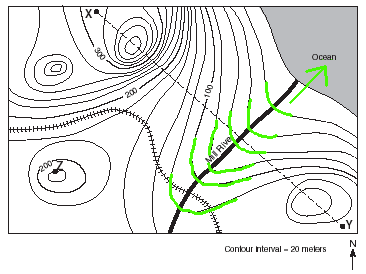
Contour lines bend upstream when crossing a river.
A contour interval is the
difference in elevation between two contour lines that are side by side.

Highest possible elevation of a hill

Depressions are shown by small marks pointing inward off the contour line.
Gradient

Monday, September 9, 2013
Rick Wormelli: Redos and Retakes Done Right

Essential Questions
1. Who did Rick Wormeli write this article for and why
did he write this article?
2. Identify three important ideas or points Rick Wormeli makes in his article.
3. After you have identified three important ideas, state
whether you agree or disagree with each idea.
4. After you have stated whether you agree or disagree
with each idea, find and use evidence in the text that support
your response.
Tuesday, September 3, 2013
Fair Policies [Opening Assignment / Common Core Performance Task # 1]
Every year teachers work
on determining a fair classroom policy that takes both the teacher and students
into consideration. It’s tricky, it’s tedious, and sometimes controversial. However, education professionals like Rick Wormeli
offer some answers. Rick Wormeli, one of the first Nationally Board Certified
teachers in America, is a national education consultant and author. He
has taught Math, Science, English, Physical education, Health and History for
over 20 years.
Assignment #1: Performance Task
(September 3rd, 2013)
Read the article “Redos
and Retakes Done Right” by Rick Wormeli. As you are reading, please annotate,
which means you should highlight important ideas or ideas that stand out,
make notes for yourself that will help you understand the text, and identify
the article’s purpose for writing the article. As you are
annotating, answer the following questions as you are doing the above:
(Please complete this work on paper you can hand in)
1. Who did Rick Wormeli write this article for and why
did he write this article?
2. Identify three important ideas or points Rick Wormeli makes in his article.
3. After you have identified three important ideas, state
whether you agree or disagree with each idea.
4. After you have stated whether you agree or disagree
with each idea, find and use evidence in the text that support
your response.
We will discuss your
responses as a class, so be ready to share your ideas. When you share
your responses, try and use the text as you share out.
Watch the following videos to help you in this assignment.

If the clip doesn't work, click this: Rick Wormeli Part 1

If the clip doesn't work, click this: Rick Wormeli Part 2
Wednesday, August 14, 2013
Class Syllabus
Here are snapshots of the class Syllabus. There is a PDF file for it located under Pages. Check it out!


Women in science: Women’s work

Science remains institutionally sexist. Despite some progress, women scientists are still paid less, promoted less,win fewer grants and are more likely to leave research than similarly qualified men. The reasons range from overt and covert discrimination to the unavoidable coincidence of the productive and reproductive years.
In this special issue, Nature takes a hard look at the gender gap and at what is being done to close it. A survey of the data (see page 22) reveals where progress has been made and where inequalities still lie, from salary to tenure. A News Feature (see page 25) reveals a particular dearth of women in some commercial spheres, such as on the scientific advisory boards of biotechnology firms, and an article by historian Patricia Fara (see page 43) traces the wearying stereotypes perpetuated by the biographers of women scientists.

Nature special:nature.com/women
A series of Comment articles looks at possible solutions. Neuroscientist Jennifer Raymond (see page 33) calls on both sexes to recognize and reduce their biases against women in science, and eight researchers from around the world offer their prescriptions (see page 35), from equalizing the retirement age in China, to liberalizing travel restrictions in Saudi Arabia, to boycotting conferences that lack female speakers. We catalogue some of the ambitious moves being made in Europe to get more women into top positions (see page 40) and explore some surprising statistics about mandatory quotas (see page 39). Finally, profiles of four successful 30-something women (see page 28) show how ambition and talent can trump obstacles.
This special issue is dedicated to the memory of Maxine Clarke. In the 28 years that Maxine spent championing the highest scientific standards as an editor at Nature, she was all too often the only one to ask, “Where are the women?”
http://www.nature.com/news/women-in-science-women-s-work-1.12547
Subscribe to:
Posts (Atom)