Tuesday, September 24, 2013

Constructing a Topographic Profile

Aim: How do we map the surface of the Earth?

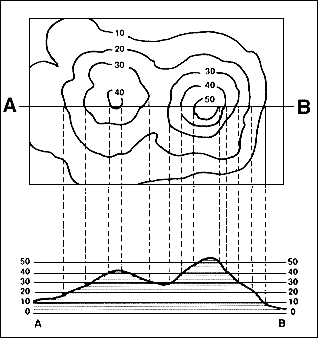
profile is a picture of what the landscape would look like from the side. It is a cross section of the landscape. You should be able to identify a correct profile, as well as draw one.


Given the topographic map above, which of the four choices below accurately depicts the correct profile between points X and Y?


Easy Peazy Steps to Constructing a Topographic Map Profile:

A profile may be constructed quickly and accurately across any straight line on a map by following this procedure:
a. Lay a strip of paper along a line across the area where the profile is to be constructed.b. Mark on the paper the exact place where each contour, stream and hill top crosses the profile line.
c. Label each mark with the elevation of the contour it represents. 
d. Prepare a vertical scale on profile paper by labeling the horizontal lines corresponding to the elevation of each index contour line.
e. Place the paper with the labeled contour lines at the bottom of the profile paper and project each contour to the horizontal line of the same elevation.
f. Connect the points.


Monday, September 23, 2013

Structure of the Earth

Important Ideas

1. How are the layers of the Earth's interior differentiated?
2. How does the composition of each layer
3. How does activity taking place in the interior affect the activity and physical nature of the Earth's surface?


Independent and Dependent Variables (Answers)

 
1.  A group of college students were given a short course in speed-reading. The instructor was curious if a monetary incentive would influence performance on a reading test taken at the end of the course.  Half the students were offered $5 for obtaining a certain level of performance on the test, the other half were not offered money. 
 
Independent variable:  Monetary incentive ($5 or no money)
 
Dependent variable:  Performance on reading test
 
Experimental group:  $5 group (receive monetary incentive)
 
Control group:  $0 group (no monetary incentive)


2.  A social psychologist thinks that people are more likely to conform to a large crowd than to a single person.  To test this hypothesis, the social psychologist had either one person or five persons stand on a busy walking path on campus and look up.  The psychologist stood nearby and counted the number of people passing by who also looked up.
 
Independent variable:  Size of group (5 people or 1 person)
 
Dependent variable:  Conformity (measured by number of people looking up)
 
Experimental group:  People passing 5 person group
 
Control group:  People passing single person.  (This group gets “less” of the independent variable)
 
 
3.  To test a new voice feature in a cockpit design a flight simulator was used.  The simulator was programmed to give visual readings of flight information, or to give visual and auditory (voice) readings of flight information.  All test pilots were put through a simulated emergency landing procedure, but were randomly assigned to the visual, or visual and auditory conditions.  Flight experts rated each pilot’s performance in the simulator on a scale of 1 (very poor) to 10 (excellent).
 
Independent variable:  Presence or absence of auditory (voice) readings.  (All pilots received visual readings, so that is a constant variable.)
 
Dependent variable:  Ratings of pilots’ performance
 
Experimental group:  Pilots in auditory readings condition (visual + auditory)
 
Control group:  Pilots in visual reading only condition (no auditory)

Thursday, September 19, 2013

Independent and Dependent Variables

1.  A group of college students were given a short course in speed-reading. The instructor was curious if a monetary incentive would influence performance on a reading test taken at the end of the course.  Half the students were offered $5 for obtaining a certain level of performance on the test, the other half were not offered money. Based on the situation presented, identify the:

Independent variable:
Dependent variable:
Experimental group:
Control group:


2.  A social psychologist thinks that people are more likely to conform to a large crowd than to a single person.  To test this hypothesis, the social psychologist had either one person or five persons stand on a busy walking path on campus and look up.  The psychologist stood nearby and counted the number of people passing by who also looked up.

Independent variable:
Dependent variable:
Experimental group:
Control group:


3.  To test a new voice feature in a cockpit design a flight simulator was used.  The simulator was programmed to give visual readings of flight information, or to give visual and auditory (voice) readings of flight information.  All test pilots were put through a simulated emergency landing procedure, but were randomly assigned to the visual, or visual and auditory conditions.  Flight experts rated each pilot’s performance in the simulator on a scale of 1 (very poor) to 10 (excellent).

 Independent variable:
Dependent variable:
Experimental group:
Control group:

Monday, September 16, 2013

Density

Densitya measure of the compactness of a substance, expressed as its mass per unit volume.

Density = mass (g) / volume (mL)
 
Mass - a measure of how much matter is in an object.

Volume - the amount of space occupied by a three-dimensional object or region of space.